
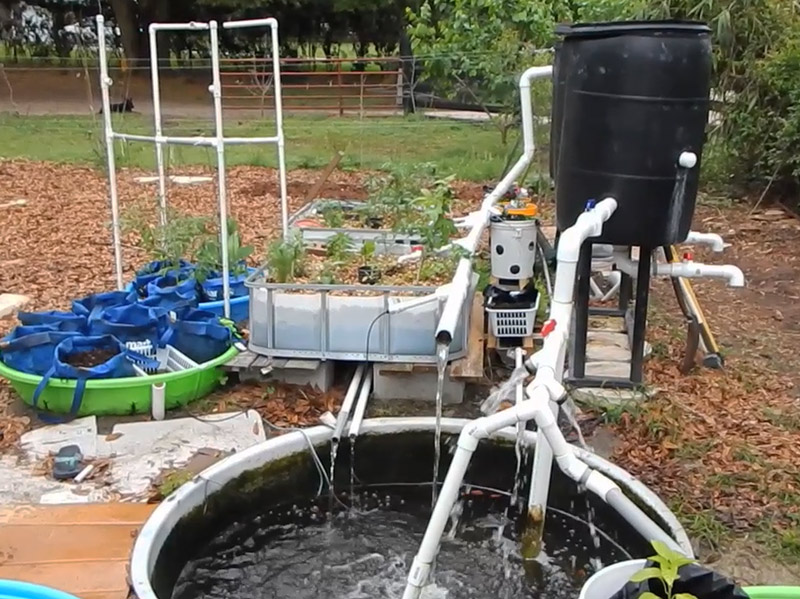
When I first discovered aquaponics, I was fascinated. The idea of raising fish and vegetables in a closed loop was eye-opening. This could be the food revolution of the future!
In an aquaponics system, a gardener raises fish in tanks. The water of the tanks is pumped through beds of plants and sent back to the fish with much of the nitrates removed and used for plant growth, cleaning the water and keeping the fish (usually tilapia) happy.
In a nutshell, the fish poop and the plants use that poop to grow – and you get a crop of meat and vegetables from your aquaponics garden.
The system sounds easy and fun. The plants never wilt and never need feeding, thanks to the always flowing water around their roots. The fish grow and provide you with all the meat you’ll ever need in a much smaller space than a traditional pond.
Yet over the years, I have gone from enthusiastic to downright opposed to aquaponics as I’ve seen multiple systems created by multiple people and organizations, and seen very little to recommend them as a viable alternative to growing in the ground.
One friend has had all his fish killed multiple times due to failed pumps and drains. Another friend has worked with aquaponics in his backyard as a hobby for years for very little return in fish.
Locally, there is a non-profit organization promoting aquaponics systems and installing them at schools. Why? Because it’s sexy!
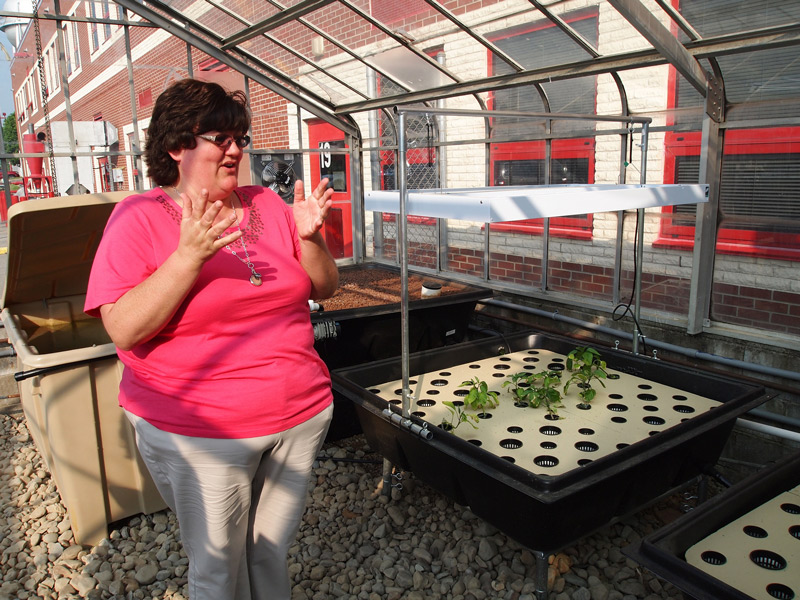
That’s not the reason they give, of course. No, they legitimately think it’s a great idea and a revolution and all that nonsense. The crazy thing is that they’re promoting this mess of complicated plastic and pumps in a place where the soil is rich, the climate is mild and there are millions of fish in the sea.
It would make a heckuva lot more sense to plant a bed of yams and go fishing than to attempt to balance pH and water levels and breed fish in a tank.
Are Aquaponics Even Profitable?
Can aquaponics be profitable, especially compared to a traditional garden?
According to a report by the Southern Regional Aquaculture Center:
“The most challenging aspect of managing an aquaponics operation is to develop a realistic, accurate, and workable marketing plan. Raising fish indoors is two
to three times more expensive than raising fish in open ponds. Thus, a profitable aquaponics operation will need to seek out and develop a market that will pay a higher- than-average price for the crop. An in-depth understanding of the level and type of competition in the market place is essential. For example, an individual who raises lettuce in aquaponics will need to compete with lettuce sold in WalMart, in other grocery stores, and at farmers’ markets. Why would an individual buy aquaponically grown lettuce, especially if it is more expensive than other types? The seller must have a clear answer to that question to be competitive.
A second marketing consideration is that the type of high-end market that will pay a premium price will also entail greater marketing costs. For example, if the freshness of the produce is a main reason for a top chef to pay a premium price for aquaponically raised herbs, that chef may want frequent deliveries to ensure that freshness. Frequent deliveries will require additional personnel, vehicles, and associated mileage expenses.
Labor requirements must also be considered. An aquaponics system requires frequent attention. Even on a small scale, aquaponics systems are complex because of their multiple components and requirements. Disease prevention, water level control, and preventing rodents and other problems require inspection and care of the system throughout the day, 7 days a week.”
Yet even if you manage to work out these details, the report further notes:
“…the fish portion of the aquaponics system was not profitable, with the production costs of tilapia less than market price in only one study, and either higher or essentially the same in the others. This also is consistent with anecdotal reports that the fish portion
of aquaponic systems tends to be a net loss, with profits primarily from the vegetable portion.”
And the profit margins from the vegetable portion aren’t all that hot.
K.I.S.S.
“Keep It Simple Stupid.” When I was working on a college newspaper long ago, the journalism professor overseeing the paper hung a sign on the wall that read “K.I.S.S.: Keep It Simple Stupid!”
Don’t clutter up your stories with needless detail. If a witness is sharing her story, you don’t have to note that the witness wore “tennis shoes and a purple blouse,” unless she was a witness at a fashion show.
When you add lots of pipes and aeration and electricity and fish and gravel and valves, etc., etc., etc., to your garden, you are making the system complicated. This isn’t to say it won’t work, but it does allow in many more chances for error and problems.
The argument that amazes me is that “aquaponics makes sense!”
No, it doesn’t, except in certain applications. It’s a needless cluttering of gardening. It appeals to smart people who like to tinker, but that doesn’t make it better than forking up a bed and planting seeds in the ground. Some of us really like to build things and create systems and that’s fine. You are NOT a bad person because you like aquaponics. I know lots of people that like aquaponics. It’s a great hobby, but from my observations over the years, it’s an inferior form of gardening. Once you shell out the time and labor and money for parts, you are in the hole. When your fish die because the pump seizes up, you are further in the hole. And also – I’ve seen a lot of sad, yellowing plants in aquaponics systems. Tweaking that fish/vegetable loop isn’t easy, even though in theory it works awesomely!
Give me a fork, a hoe, some seeds, sunshine and water… and I’ll grow you some food without spending much time or money. I can plant corn or yams and walk away for a week or two, then come back and spend a little time weeding, then walk away again.
You can’t do that with aquaponics. And promoting it in the third world as a great alternative agricultural method is beyond silly. Tons of plastic and Styrofoam and more plastic…
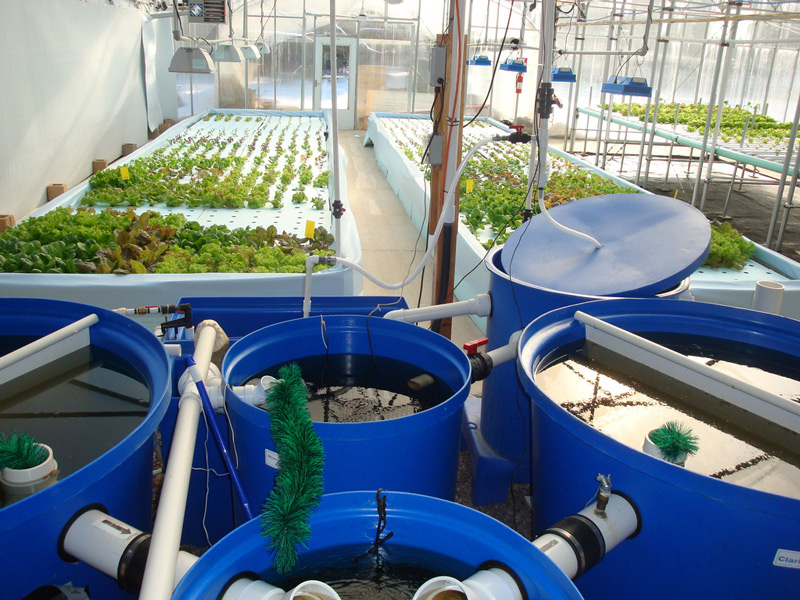
Farmers here know how to grow food already, without first world nations spending money and promotional time to explain why they should switch to delicate and complicated systems based on plastic and technology.
I think it’s hubris. We know better than you – and we know better than nature! And look at how impressive all this is to newbies! It is SCIENCE!
Give me this garden any day:
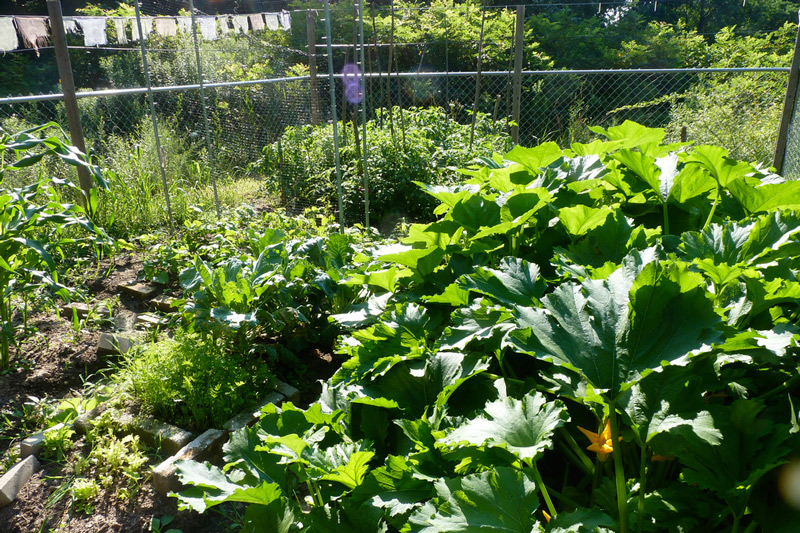
You could create that garden for a few dollars, a few afternoons hard work and zero plastic.
I am over the aquaponics virus!
If you think I’m wrong, tell me how – I’d like to hear your thoughts.
(And Larry… sorry I used your picture at the top. I hope your fish are still alive.)

39 comments
Similar here: it looked so cool, and a friend of mine has a pretty neat setup. But… every time I looked into it myself, it was too expensive, too complicated, and I’m not into using electricity to grow plants. Also: couldn’t figure out what to do in a power outage, and our area is prone to them. Plants are solar-powered anyway. Friend has pretty good results from her system, has harvested fish, grown a lot of vegetables, and never had much luck growing in the ground (lack of soil, dogs, etc). Not for me, though.
I think certain personality types gravitate towards building and maintaining complicated systems.
You are correct, and it’s typically pretty smart ones, we also have the mental ability to juggle what ends up being a likely quadrupling of variables with more than few of them being so important they mean literal life and death within a day, or even hours lol.
But you couldn’t be more correct concerning needless complications and money for things like nearly worthless fish and extremely low value crops like lettuce, or even strawberries means only those who simply enjoy it should even think about it.
I build custom hybrid closed loop, DWC bucket systems with either soft or hard pvc pipe, my most current design incorporates secondary reservoirs that the aeroponically fed buckets drain into before returning to the main control unit reservoir for both a twirl and electric filtration that pumps them back into rows of buckets, allowing my continuous flow closed loop the ability to turn the water over 13x an hour. Aquaponics would obviously be very easy for me to walk into, regardless, my reasons and the two having a great deal of similarities ends there.
I grow high EC crops, and efficiency, no waste, and precise control over nutrient cycles using roughly 11 different nutrients/additives, trying to waste little to no water on a weekly water changing basis utilizing aeroponics in my buckets with those levelers sitting low enough only about a gallon of water standing water remains, with the rest falling into my secondary reservoirs or in my control unit/primary reservoir that are both sealed and completely dark, which translates into nearly no water waste with my temp range 71°F-74°F, all lighting, cooling, ph control, fans done automatically on timers or with thermostatic temp ranges that turn them off once below my lower range, with me also recently building a two stage filtration system to scrub/clean the heat waste and air coming out of my greenhouse, which is then finally transferred into my attic, blowing back down to my forced air central heating furnace’s intake, which allows me to just run the fan to heat my house at night in the winters infinitely cheaper. The point I’m trying to make really is my system though super costly up front, is now so efficient, producing the biggest quality yields of any method, wastes little to no water, and is even heating my home minus perhaps parts of Dec/Feb, all of January!
I see those huge basically open tanks filled with obscene amounts of water that absolutely evaporates at a great rate all summer long, positive they’re too warm, icky and ripe with fish shit, algae and who’d want to know how much ecoli and other disgusting bacterial blooms flourishing the hotter it gets, would love to know how many users have been infected with Vibrio, a life threatening bacterial disease that is usually antibiotic resistant, now knowing Tilapia are favored, and methinks these people shouldn’t so much give up aquaponics as they should transfer to a nice clean hydroponics system made to save the most money. Haven’t done it yet, but I eben have plans for building outdoor, summer resistant systems, with primary/secondary reservoirs, along with the first half foot of the bright white buckets also below frost line with a decently air tight manifold covering everything, so one neither needs a chiller or commercial grow lights to operate it, even if I wouldn’t not install a chiller able to quickly cool it down because I know hydro means complete control of completely everything 24/7/365 or don’t even think about doing it. Aquaponics may operate in a similar way, but for the expert it looks like the very opposite of efficiency. Thanks but no thanks, and that fish shit nutrient savings hack is not only disgusting, but absolutely criminal for any fruits/flowering that are known for their flavor. The cross contamination dangers are the final straw,vand I can finally state my flirting with aquaponics perhaps at home one day have officially ended, and those doing it would be si much happier doing simply hydro, building for efficient,relatively uncomplicated harvests of more valuable crops to choose from, while eliminating everything wrong, disgusting and needlessly/potentially costly with aquaponics. Fish shit romaine lettuce, yes I know I know fish waste is indeed a very powerful organic form of nitrates, phosphates andbother beneficial bacteria and micronutrients that accelerate root growth, which I can replace with far cleaner and more effective organic fertilizers, micronutrients and specialty additives that are free of everything disgusting and potentially cross contaminating during harvest. Thanks but no thanks, methinks these cool but makes me very sad and ful of pity aquaponics aficionados, while making the switch to hydro I insist, at least if they’re good at it would be so much better off concentrating on the efficiency I so very much love and continue to develop 21 years later of both personal and commercial experience, and I’m 100% positive they will soon be thriving as long as they understand the integral need to keep reservoir water loaded with nutes/mychorizae/bacillus bacterial innoculents at a minimum under 67°F, but with the mid 50°Fs the perfect temperature indefinitely (a temp many claim is too low, which is complete garbage, especially having a 10°F-17°F buffer for when the power goes out, or pump failure occurs for so many more reasons than you ever want to consider) with the largest 16 manifold air pumps, stones doing the same in unison (1 in buckets/2 in bigger reservoirs), and these aquaponics users will likely have immediate success possessing the experience they’ve earned successfully managing what I refer to as ‘The Ballet of Next Level Growth”. I’m new here, but I’m going to join, would love joining these kinds of conversations currently happening, and anyonebwho may see me feel free to contact me to ask any questions hydroponic, because I’m generally at the skill level of Master, honing out the occasional chinks I occasionally confront, along with the polishing of the tiny details that all add, however small, to overall efficiency and conservation of power. There’s really no problem I haven’t confronted, bested either, and I’d be thrilled solving yours too!
I’m not sure if the show is still on TV, but Doomsday preppers was fun to watch. some of these guys have a lot more money than brains and their setups are really intended for similar people. There were a few that had aquaponic systems. I always thought that it was a convenient way to have both meat and fish available for harvest…but the more I inquired, the more complicated it seemed.
When I was a young man and wanted to sup-up my car, my dad would always tell me…the more stuff you put into the car, the more stuff that can break down. Same goes here. Besides, in a TEOTWAWKI scenario…electricity will be a luxury, and even with a generator, you would have to ration use. I don’t think a aquaponic system will survive.
KISS really is the best advice.
Seems these systems are really good at one thing though….showing them off.
Yeah. I’m just amazed at how they’re setting them up at schools, with all this complicated junk, and meanwhile the kids are eating mangoes and bananas at home from their parents’ trees. It’s silly to think it’s better.
David, I have a question for you….
I have 4 raised beds in my yard in South Florida (Miami). I know you’re not a fan (of raised beds…if you were in Miami you wouldn’t be a fan of that either ((the people suck)) )
anyway…I can’t dig 4 inches without hitting rock. I have been contemplating putting my next bed right in the ground, but not sure how the plants would do with such rocky ground.
any advice?
Yes. Miami is a mess.
If you only have four inches, definitely go up. My main problem with raised beds is that they use a lot of water, especially in Florida. I think in your case I’d make some tall ones with lots of organic matter in them as a sponge, then water as needed.
What about creating floating garden beds in a natural pond/water feature? I believe they have been doing it for quite a while down in portions of Mexico, and I am sure other places as well. How easily do you think something like this could be scaled down, and what do you think would be the limiting factors?
I think it would work. I would skip the easiest method, though, and dodge the styrofoam! That stuff is just nasty.
I have seen some wicking bed systems that seem to work well. Limiting factors? Mosquitoes and lack of good organic ways to make it happen.
I’m with you on the fishing. Way more fun and rewarding,plus tilapia meat is the wonder bread of fish. Give me a nice spanish Mackerel or redfish or spotted sea trout instead. When you get home, clean your catch and feed the rest to your plots.
Yes. Tilapia is blah.
Indoor aquaponics may be a failure, but combining fish with rice paddies is common in parts of Asia.
Oh yes. It makes sense to integrate plants and animals in a lot of systems. Grazing paddocks, ponds, etc. I love that sort of thing. Must less complex and no PVC required.
I have spent gobs of time theoretically designing a aquaponics systems. But as years have gone on, some of the experts in aquaponics have said that, it is simply too complicated and there is too much that can go wrong. I would still like to grow fish in my backyard, and our climate is such that I wouldn’t need to heat the water for most of the year, and I’d just need to run the filter. As an aquarium enthusiast in my youth, I know what it takes to keep fish happy healthy and thriving.
So, the best system I saw which I would like to imitate, in my opinion, was a giant outdoor tilapia pool, but they filtered the water several times using swirl type filters before returning the clean water directly to the fish. So less electricity was used and the water was more oxygenated. They collected the settled fish waste from the swirl filters and poured the concentrated fish poo into their regular in-the-dirt garden with amazing results. And I can attest to the awesome fertilizing power of fish waste. I kept goldfish for a while just so I could use the fish waste in the garden. Liquid magic for all plants. But yeah, aquaponics is too complicated.
I wish I could just go fishing in the huge Indian river only a couple miles from my house, but the local Cocoa Water plant keeps killing off all the fish in the river by dumping not treated sewer waste into the river. Fishermen have seen human poo washing up on the silt islands in the river. So we aren’t eating fish out of the river. And don’t get me started on the half cent tax raise that is supposed to be used to clean up the Indian River Lagoon. What’s the point in what’s the use of raising taxes and placing a seasonal ban on fertilizer use to protect the lagoon and river when the Water treatment plant is just gonna dump the sewer waste of four huge cities right into the river?!
What were we talking about? Oh, that’s right. Aquaponics…
Wow, Erin… that is disgusting.
I would totally put in a large pond and stock it if I could.
Why is aquaponics still a topic 30-40 years after it was actually new? Personally, I believe it is part of our culture’s techno-gadget fetish. We – as a culture, maybe not individually – seem to think anything more complex is automatically better than the simpler version.
I think you hit the nail on the head. I just finished a big video on aquaponics and I’m going to post it tomorrow. You’re spot on.
Hi, huge problem these days.. clearly David or the quoted aquaponics practitioners do not know how to make an aquaponics work nor does literally know what a right aquaponics is or could produce, so talking about! Can you imagine how misinformation with limited knowledge on the subject spreads like wildfire over the internet?
David the good, or not? :) Have a look at here http://www.nardc.in. There are several videos for you to get a grasp on what we have been doing and will continue to do. Cheers!m
You aren’t going to convince anyone by being passive-aggressive.
Apologies David if you look at it as a hostile or insulting remark. I really didn’t mean it. See, it all depends on what you do in the name of aquaponics trying to integrate 5000 year old aqua culture techniques with hydroponics methodologies known to us for several decades. I loosely follow Dr Mark McMurtry’s integrated aquaculture olericulture techniques using sand as the media for the past 3 years or so successfully You may have trialled its various mutations and/or gizmos and gimmicks just like me for several yewrs and made your opinions. Did you see some of my videos and stories?
I think it is cool in theory, and yes, it does grow fish and food, but is it the BEST and most productive way to grow food or even fish? No. Aquaponics seems like a closed loop system at first glance, but it actually isn’t. It requires the constant input of electricity and fish food and additions of pure water. The amount of water to set up an aquaponics system is about the same amount of water needed to maintain a garden of the same size for a growing season. Water conservation is supposed to be a bonus of aquaponics, but really, in aquaponics you input the water all at once at the start, whereas in a dirt based garden, it is input slowly over time. Aquaponics is cost prohibitive to set up, has limits on what plants will grow in aquaponics, and is not self sustaining. Perennial vegetables, fruit and nut trees will, if planted well initially, require less maintenance over their life span, cost less, and produce more food than an aquaponics system in the same amount of space without constant inputs.
I would politely disagree on a few points. I would have to see the figures , but I have doubts that you the same amount of water that you use on a garden. Evaporation would be the only time you would be adding water… some of this might be taken care of by rainfall… as it would on a garden. Electricity is also used for gardens… water your garden=using electricity…..though I would admit…the pump is using more because it is going on all the time…. hmmm … could gravity be used…..to help decrease the pump situation?
I don’t disagree with all your points… but to be fair.. it is good to look at all sides of the issue.
I love aquaponics. Does it work? Yes. Can it be complicated? Yes. Does it have to be? No. Is it a survival gardening method? no… but sometimes yes. Is it worth trying and experimenting with … instead of just observing a few friends failed attempts…. yes.
Please, point out some simple productive low-input aquaponics systems. I truly want to see some. I’ve read all the most popular aquaponics books and have experimented with some simple indoor fish tank based systems. They turn out to not be simple, but are certainly unproductive.
I was at lowes one day… and they announced they were getting rid of an outdoor pool for 50 bucks… It held about 1400 gallons. I bought a 60 dollar pump. I found some guys selling small tilapia for 50 bucks….. I went to a junk yard and got some old plastic bill boards that I used to help line a sump tank. It was cheap…I don’t remember exactly…maybe 5-10 bucks. I bought a liner for the sump… once again… it has been awhile but I don’t think I paid more than50 or 60 bucks…. so 220 bucks or so…..
It is a hobby…. I enjoy it….it is fun…. at this point … I will not say it is a serious survival gardening alternative… with my experience…. but I could see some possibilities…. it is fun…. not anymore expensive or impractical than many gardeners attempts…. at least not the way I did it
What media did you use for the grow beds? Or are you doing a flow-through bed with rafts?
I used the cheapest river rock I could find…. forgot about adding that cost….tell the truth I don’t remember… but it wasn’t to bad
okay… stopped before talking about grow beds…. 1st one… I built from wood and liner…. next 3 ,,, I was lazy… and bought plastic horse troughs…10 ft long ..10 inches deep… not ideal but easy… got them from tractor supply…. so there is some more cost…. don’t remember the cost… but I’m sure you can find it on their website. so I’m guessing they were 100 bucks each..
Recently read Rodney Stark’s latest book, The Victory of Reason: How Christianity Led to Freedom, Capitalism and Western Success. He discusses how medieval European farmers learned to utilize the extremely high fertility of fish farms by peridocally draining the ponds to plant crops in them. They would rotate plots of land for this purpose throughout the growing season.
That sounds like a fascinating book. Reminds me of what I read in “Farmers of 40 Centuries.” Asian farmers were recycling everything and using the canals to create fertility.
Excellent and much needed, David. Aquaponics is definitely enticing. It just sounds so good! But the difficulty of maintaining a balanced and trouble-free water environment like that is grossly underappreciated by most people. Anybody who has tried to keep fish can attest to that. It can be done, obviously, but it’s not easy, nor inexpensive.
Just look at all the antibiotics that are marketed to fish keepers. That’s indicative of the difficulties in keeping healthy fish.
I’ve been attracted to this myself, but eventually was turned off by the complexity and expense. Luckily I didn’t have to find out the hard way. (That’s not to say I haven’t wasted too much money on similar things in my lifetime!)
Everyone has different experiences. Mine were easy peasy… I didnt overcomplicate things… and as a side benefit , I had a great swamp garden to help filter the water for the fish… along with the traditional grow beds. Maybe I just got lucky….I am already missing my swamp garden. The only negative… buying food for the fish… I also hate buying food for my chickens…. my dream is to someday figure that one out.
Aquaponics is a first word solution for a third world problem. I have been looking for a way to get people to grow using ap for over ten years. It comes down to this….. the internet was the first step towards a new type of civilization and since we turned it on we have never turned it off or can we turn it off. ap is the next step in evolution, it is the only way to move from oil based farming. First world nations have no need for ap because of your food distribution network is very effective. in fact most people under 5 years think food comes from the supermarket. with out oil the importance of Ap will become apparent.
I would love to hash this out with you as i believe AP is a must and every convert counts. the fact remains that people keep pet fish all the time with no chance of financial gain. Why not Aquaponics?
Greetings. Here is the link to a youtube time lipse of back yard farm that addresses many of the issues discussed in your essay and video. Soon there will be more and more that do the same as aquaponics advances. So please be a bit kinder to us. Humans have been soil farming for millennia. It will take aquaponics a little while to catch up but we are getting there.
Here is the link: http://bit.ly/2jyPsIs
Enjoy
P.S. Many US cities like my own Phoenix Arizona (5th largest city in the US) are now embracing urban agriculture as a powerful means of creating local healthy, abundant, sustainable food as well as the powerful new circular economies it creates, for STEAM education in the schools and for the mitigation food deserts. Authorized by its new general (business) plan Phoenix for example is now starting to create webpages promoting urban agriculture, the problems it solves and aquaponics is listed as one of those solutions that people can use go grow food in the city. Here is the link to one of those pages. Enjoy: http://bit.ly/2GljlW0
[…] About a week ago, Permaculturist David the Good released a YouTube video called “The Aquaponics Delusion – Why Aquaponic Gardening Doesn’t Make Sense” in which he canvassed his concerns with aquaponics. The ensuing reaction from elements of the aquaponics community caused David to pull the video but the gist of his argument can be found in this article. […]
[…] About a week ago, Permaculturist David the Good released a YouTube video called “The Aquaponics Delusion – Why Aquaponic Gardening Doesn’t Make Sense” in which he canvassed his concerns with aquaponics. The ensuing reaction from elements of the aquaponics community caused David to pull the video but the gist of his argument can be found in this article. […]
I think aquaponics is just a fad or hobby. I have run 3 very differently setup systems for 5 years and I can’t say that the results were very impressive. We still grew better produce in the ground for way less cost and labour. Part of the trouble is you have all these YouTube experts and money grabbers running courses teaching people the wrong way to set these systems up. Keep it simple stupid is definitely the correct approach. Media beds are a complete and utter waste of time. Don’t waste your money and labour on clay media beds, instead invest in a quality particle and moving bed biomass filter. Set up a closed loop aquaculture system then mineralised the solids backwashed from the filters to irrigate soil or wicking beds and pots. This way you get the benefit of utilising your fish waste but growing your fish out in an ideal system without compromise. Most importantly, however, get the source water tested to ensure it will be suitable. There’s no point in investing in an aquaculture or aquaponics system if your source water is crap. This is the main problem I have encountered with systems. It is a huge amount of work to run an aquaponics system on any scale. Unless you build a big, like huge system, it will not be viable.
I’m so beyond done dealing with soil nematodes and heat stress and endless watering and water waste in constantly-in-a-drought-with-100-plus-degrees-weather TX and will be giving aquaponics a try. It doesn’t make sense in some places, but as with most things, there are times and places for it.
Comments are closed.